Time and consistency remain undefeated. I've been turning that line over this week, against a very loud backdrop.
On 26 October, Anthropic, the company behind Claude, filed publicly to list on the Nasdaq. Its prospectus warns investors that advanced AI could "pose catastrophic or existential risks to humanity". That is a remarkable sentence to find in a share sale document, and it deserves the attention it's getting.
But there's a quieter risk I see every day in my own industry, and it won't make the front page. It isn't that AI ends the world. It's that AI makes the world sound the same.
We spend our days at Explosive Brands helping health companies explain why what they do matters. In the last couple of years I've watched our tools change faster than at any point in fifteen years of running the agency. Some of that change has been brilliant: work that took a week now takes an afternoon.
Yet something else has crept in alongside the speed. Pitch decks that read like each other. Brand ideas that could belong to anyone. Feeds full of posts with the same rhythm, the same three-part lists, the same tidy conclusions.
This piece is my attempt to make sense of that, and the argument is simple. AI has made execution cheap. It hasn't made experience cheap, and it can't. When everyone can produce the average, the value moves to the people who can see past it. Those people are made the slow way: by time, by craft, and by the people who taught them.
To understand why this happens, it helps to know what these tools actually do. A large language model learns from a vast amount of human writing. When you give it a prompt, it predicts what is most likely to come next.
That's an extraordinary capability, and it comes with a built-in pull. Ask a generic question and you'll get the most probable answer: the one that sits closest to the centre of everything the model has seen. Left to itself, AI gravitates towards the mean.
Here's an easy way to picture it. Ask a thousand people to describe a sunset, then blend their answers into one. You won't get a bad description. You'll get a postcard: every word in the right place, nothing you'll remember.
I want to be careful not to overstate this. Used well, these tools can surprise you. They can combine ideas in ways you wouldn't reach alone, and I use them every day to widen my thinking. To say AI can never produce anything new would be wrong, and anyone who works with it seriously would tell you so.
The point is narrower, and I think more useful. Left to its defaults, AI gives you the likely answer, and the likely answer is by definition the average one. The unlikely answer, the one that makes people stop scrolling, is still your job.
That matters because of how most of us use these tools. We type a request, accept the first decent result and move on. The tool did exactly what it was built to do. We're the ones who stopped thinking.
Now multiply that by everyone. Millions of people are using the same handful of tools, trained on similar data and asked similar questions. Don't be surprised when your writing and your ideas start to look and sound a lot like everyone else's. They probably are.
There's research that puts evidence behind this instinct. In a 2024 study in Science Advances, Anil Doshi and Oliver Hauser asked 300 people to write short stories, some with AI-generated ideas to draw on and some without. The AI-assisted stories were judged more creative on their own, but they were also more similar to each other. And the writers who were already the most creative gained little from the AI at all.
That's the whole story in miniature. AI lifted the floor, but it didn't raise the ceiling. As everyone's work moved towards the middle, the collection as a whole became less diverse.
You can see it on LinkedIn every morning. Posts that open with a one-line hook, a dramatic pause, a numbered list of lessons. Perfectly structured, grammatically flawless, and somehow empty. It's giving a lot of people the ick, me included.
What's interesting is the reaction. More and more people seem to want a little imperfection. A sentence that runs on. A turn of phrase only one person would use. Writing that sounds like someone talking, rather than a press release about someone talking.
That isn't nostalgia, it's a signal. When polish becomes free, it stops being a mark of quality. What becomes scarce, and therefore valuable, is the sense that there's a real person behind the words, with a real point of view.
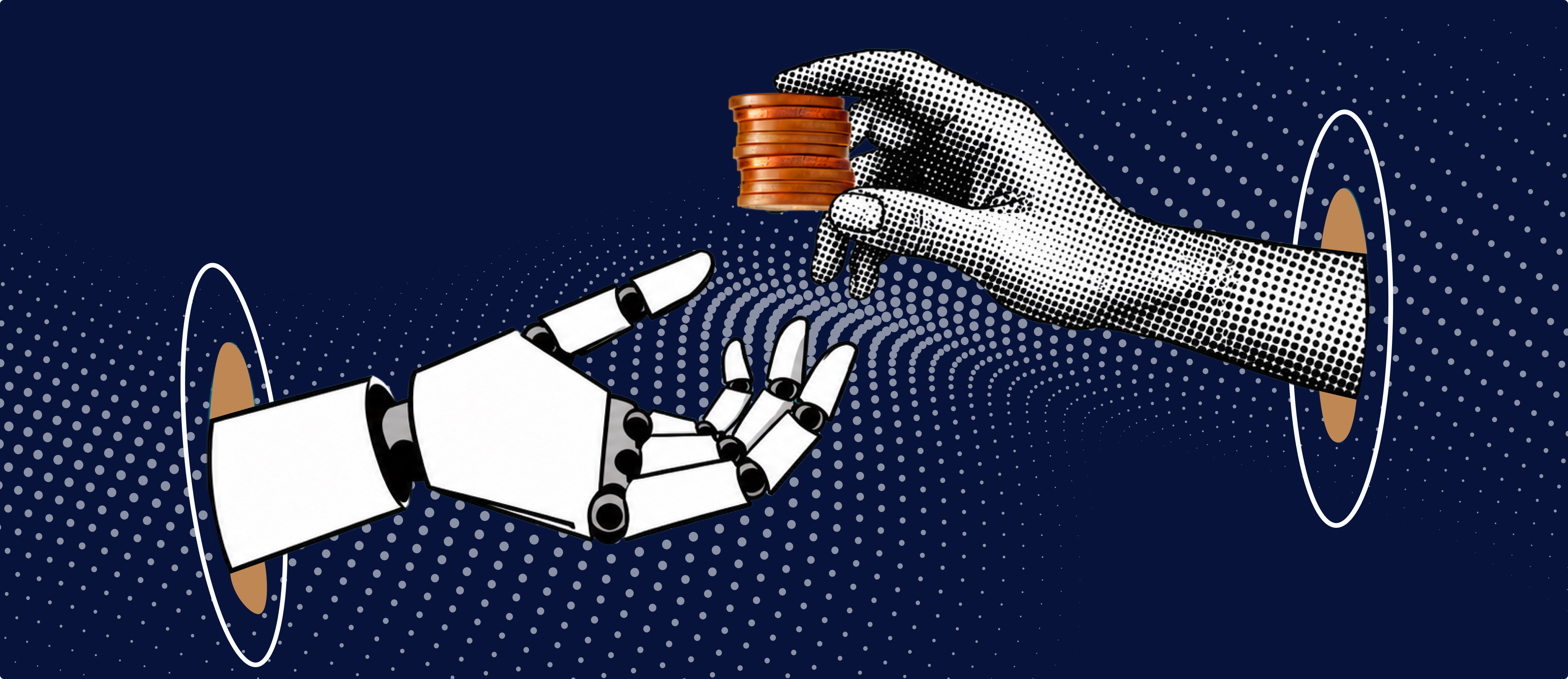
This shift matters for everyone who creates, but it hits agencies hardest. For decades our model worked one way round. We pitched an idea, often for free, and then got paid for the execution. The hours of design, writing, editing and production were what clients bought.
That model has been flipped on its head. Execution is now available to anyone with a subscription and a text prompt. A competent logo, a tidy landing page, a passable explainer script: all of it can be produced in minutes. Much of it is perfectly acceptable, and some of it is genuinely good.
So if execution is no longer scarce, what is? I think it's the part we used to give away. The idea. The insight. The judgement to know which of a hundred possible directions is right for this client, this audience and this moment.
It's a bit like what happened to photography once everyone had a camera in their pocket. Taking a photo stopped being a skill anyone would pay for. Seeing the photo, knowing where to stand and when to press the button, became the whole job. The best photographers didn't disappear; they just stopped being defined by their equipment.
For agencies, that means being honest about where our value lies, and pricing for it. If we keep selling hours of execution, we're competing with something that costs almost nothing. If we sell thinking, experience and the ability to join dots no one else would, we're selling something AI can't average its way to.
Our own way of working at Explosive Brands is built around three words: simplify, amplify, ignite. It's a useful lens here. AI can genuinely help us amplify, getting a message into more formats, faster, for more audiences. It can speed up parts of ignite too. But simplify is where the real work happens: finding the one true thing about a product that matters to the person using it, and saying it clearly. That takes judgement, empathy and a lot of listening. It's the step a prompt can't do for you, and it's the step everything else depends on.
Get simplify wrong and AI will help you amplify the wrong message beautifully, at scale. Get it right and the tools become what they should be: an accelerant for a good idea, rather than a substitute for one.
For clients, it means briefing us with a different question. Not "can you make this?" but "can you see something we can't?"
Look closely at the best work being made with AI right now and a pattern appears. It's coming from people who had honed their craft before the tools arrived. Designers with years of taste behind them. Writers who know exactly what they want a sentence to do. Strategists who can tell in seconds when an output is wrong.
These people aren't using AI to replace their thinking. They're using it to move faster in a direction they'd already chosen. Their experience works as a filter, rejecting the average and pushing the tool somewhere it wouldn't go on its own. The result is exceptional precisely because it isn't the mean.
So experience matters more now, not less. But experience isn't only years on the clock. In our world, it's built from something very specific: time spent with real people.
When we work on a health product, the most valuable thing we do often isn't in the design file. It's the conversation with someone who has lived with a condition for years. It's watching a clinician use a system at the end of a long shift. It's hearing a carer describe the moment a piece of information finally made sense.
No model has had those conversations. It can tell you what people in general tend to say. It can't tell you what this person, in this situation, actually feels. Understand the lived experience of someone who uses a product or service, and you'll often uncover something genuinely surprising. That surprise is where the work that matters begins.
So when someone opens a chat window and types "You are a brand strategist. Help me position this product," I understand the appeal. But they haven't spoken to a human being. They've asked the average of everyone to imagine one.
There's a reason so many great campaigns leave you asking, "What has that got to do with the product?"
Think of Cadbury's Gorilla in 2007: a gorilla drumming along to Phil Collins's "In the Air Tonight". According to Marketing Week, it had no chocolate, no message, and ran three times longer than a normal ad. It was nearly shelved. It went on to win the Grand Prix at Cannes Lions, and people still talk about it nearly two decades later.
Now imagine asking a tool to "write a TV advert for a chocolate bar that communicates joy". You'd get something sensible. Probably a family, probably some laughter, probably a slow close-up of chocolate breaking. It would be on brief, and nobody would remember it.
That's the difference. Logic gets you to the obvious answer, efficiently. Creativity takes a sideways step that only makes sense afterwards, joining two dots that were never meant to be anywhere near each other.
Those leaps don't come from nowhere. They come from a person who has watched a lot of films, listened to a lot of music and sat in a lot of rooms with a lot of different people. They come from the strange archive of experience each of us carries around, which no two people share.
AI can help you explore around a leap once you've made it. It can generate variations, test options and speed up the craft. But the leap itself, the moment of "what if we did this instead?", remains stubbornly human. Creativity isn't a straight line, and the tools we're all using are very, very good at straight lines.
Here's the part that worries me most. If the value is in experience, how does anyone new get experience now?
Junior roles in our industry were traditionally built on execution. You learned by resizing banners, cutting first edits and writing the first draft of the body copy. It wasn't glamorous, but it put you in the room. You watched how senior people made decisions and, slowly, you started making them yourself.
AI is very good at exactly that kind of work. If we let it quietly absorb those tasks, we'll save money this year and lose a generation of talent over the next ten. The industry will have plenty of tools and too few people experienced enough to use them well.
As senior designers, leaders and thinkers, we have a responsibility here. Not just to use these tools to deliver value for clients, but to use the time they give us back. Use it to bring people on board. Use it to teach design thinking, research, and the habit of talking to a real person before opening a chat window. Use it to show people how to connect dots in a way that isn't lazy.
It shouldn't be a one-way street, either. People coming into the industry now have grown up with these tools. They use them more instinctively than many of us ever will, and they'll find uses we haven't imagined. Our job is to pair that fluency with judgement: they can show us what the tools can do, and we can show them what the work is for.
That's the commitment I want us to make at Explosive Brands: to treat the hours AI saves us as an investment in people, not just a better margin. If every senior creative did the same, the on-ramp into this industry could be wider than ever.
So where does all this leave us? Somewhere reassuringly old-fashioned.
Time is undefeated. Consistency is undefeated. Work is undefeated. The tools will keep changing, probably faster than any of us can keep up with, but the things that make someone exceptional won't.
Hone your craft. Learn skills properly, including the boring ones. Develop ways of thinking that are yours: what you notice, what you question, the strange connections only you would make. Go and talk to people. Then, by all means, use every tool available to get there faster.
None of this is quick, and that's the point. Experience compounds the way interest does: slowly at first, then all at once. Every brief you wrestle with, every user interview that turns your assumptions upside down, every idea that gets killed in a review and comes back better, adds to an account no one else can draw on. AI can't make that deposit for you. Only showing up can, day after day, mostly when no one is watching.
A master can make something stunning with the most basic tools, because the tool was never the talent. Give a great chef a simple kitchen and you'll still eat well. Give a great designer a pencil and the back of an envelope and you'll still see the idea.
AI will make the average easier to reach than ever before. That isn't a threat to anyone who refuses to be average. It's an invitation to put the time in.
Anthropic IPO: everything to know (Stock Titan): public S-1 filing on 26 October 2026 and its risk language
Generative AI enhances individual creativity but reduces the collective diversity of novel content (ScienceDaily summary): Doshi and Hauser, Science Advances, 2024
Why Cadbury's Gorilla ad nearly didn't get made (Marketing Week)

Contact us